

WhatsApp
+90 540 490 72 15 info@turkeyadventure.com

Is the Virgin Mary Buried in Ephesus?

Is the Virgin Mary Buried in Ephesus? A Traveler’s Guide to History, Tradition & Mystery

Ephesus is one of the most historically rich places in the world, attracting millions of visitors who come to explore its ancient streets, biblical heritage, and impressive ruins. One question travelers often ask especially those visiting from Kusadasi Port or exploring biblical sites in Turkey is:

“Is the Virgin Mary buried in Ephesus?”

It’s a fascinating question, and the answer blends early Christian history, sacred tradition, archaeological evidence, and centuries of religious storytelling. While there is no definitive archaeological proof of Mary’s burial place, Ephesus plays a major role in Christian tradition regarding the final years of her life.

In this guide, we’ll explore what is known, what is believed, and why Ephesus remains one of the most meaningful destinations for anyone interested in biblical history.
What Does Tradition Say About the Virgin Mary in Ephesus?

Many early Christian sources suggest that after the death of Jesus, the Apostle John took Mary under his care as described in the Gospel of John. Tradition holds that John later traveled to Ephesus to spread early Christianity, and it is widely believed that Mary accompanied him during this period.

This belief forms the foundation of the idea that Mary lived and possibly died near Ephesus.

Although the Bible does not specify her final location, Christian tradition strongly links her last years with the region.

The House of the Virgin Mary: A Sacred Pilgrimage Site

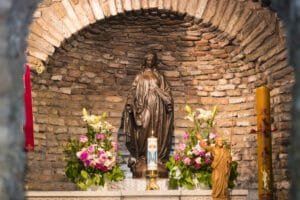
Just a few kilometers from Ephesus lies the House of the Virgin Mary (Meryem Ana Evi), a peaceful hilltop sanctuary surrounded by nature. This site is one of the most visited pilgrimage destinations in Turkey.

The location is based on:

  • Visions experienced by the 19th-century German nun Anne Catherine Emmerich
  • Archaeological investigations that followed those visions
  • Longstanding local tradition
  • Historical accounts of early Christian communities in the region

Visitors will find:

  • A modest stone structure believed to have been Mary’s home
  • A prayer area
  • A wishing wall
  • Sacred water fountains

Popes have visited the site multiple times, further reinforcing its religious significance. Whether or not Mary actually lived there, the place carries deep symbolic meaning for millions of people.

So, Is the Virgin Mary Buried in Ephesus?

The simple answer is:
👉 There is no confirmed burial site of the Virgin Mary in Ephesus or anywhere else in the world. According to Christian belief, Mary was assumed into heaven, which is why no tomb exists..

However:

✔ Many Christian traditions believe she spent her final years here

✔ Some traditions claim she was assumed into heaven (the Assumption)

✔ No archaeological evidence confirming her burial exists anywhere

Most Christian denominations, especially Catholic and Orthodox traditions, accept the Assumption of Mary meaning she was taken to heaven, not buried in a traditional grave.

Because of this belief, a burial site would not exist.

Still, Ephesus remains one of the strongest historical contenders for the place Mary lived during her later years.

Why Is Ephesus So Strongly Connected to the Virgin Mary?

There are several reasons:

1. The Apostle John Lived in Ephesus

Historical writings and early Christian tradition indicate that John the apostle entrusted with Mary’s care spent a significant part of his life in Ephesus. His tomb is located here, adding weight to the claim that Mary may have lived nearby.

2. Early Christian Communities Thrived Here

Ephesus was home to one of the earliest Christian communities in the Roman Empire. If Mary lived under John’s care, this region would have offered safety, community, and purpose.

3. The Location Fits Both Tradition and Archaeology

Scholars studying the geography, early Christian routes, and settlement patterns note that the region near Ephesus is a historically plausible location for Mary’s final home.

4. The House of the Virgin Mary Aligns With Descriptions in Visionary Accounts

Anne Catherine Emmerich’s visions described the house and its location with surprising accuracy years before excavations confirmed the presence of ancient structures matching her descriptions.

While not scientific proof, the alignment deepened global interest in the site.

Is There Any Evidence of Mary’s Tomb in Ephesus?

No tomb has ever been discovered in the region, and it is unlikely that one ever existed because of the Assumption belief.

Some Eastern Christian writings reference the Dormition of Mary, which describes her peaceful passing but not a burial.

Therefore:

👉 There is no known burial site for the Virgin Mary neither in Ephesus nor anywhere else in the world.

This is why pilgrims visit locations associated with her life rather than her grave.

What Can You See Today Related to Mary in Ephesus?

Visitors can explore several important locations:

The House of the Virgin Mary (Meryem Ana Evi)

A serene and deeply moving site for Christians and non-Christians alike.
People come to:

  • Pray
  • Light candles
  • Drink from the sacred springs
  • Attach prayers to the wishing wall
  • Enjoy the peaceful mountain setting

 St. John’s Basilica

A 6th century basilica marking the believed burial place of the Apostle John.
Since John was entrusted with Mary’s care, this strengthens the connection between Ephesus and her final years.

Biblical Ephesus Itself

Exploring the ruins of Ephesus provides context for early Christian communities, including:

  • The theatre where St. Paul preached
  • Ancient streets walked by early believers
  • Sites tied to important biblical events

Many travelers combine Ephesus with the House of the Virgin Mary during the same visit.

Should You Visit These Sites on Your Own or With a Guided Tour?

You can visit independently, but a guide adds enormous value.
Understanding biblical history, Christian traditions, and archaeological findings is challenging without explanation.

An Ephesus guided tour helps visitors:

  • Understand early Christian movements
  • Learn the stories behind each site
  • Avoid crowds and timing issues
  • Explore efficiently, especially if arriving from Kusadasi Port

Most cruise guests and first-time visitors prefer guided experiences for convenience and deeper understanding.

Final Thoughts: Is the Virgin Mary Buried in Ephesus?

There is no confirmed burial site for the Virgin Mary anywhere in the world.
But Ephesus remains one of the most meaningful and sacred places connected to her life rich with tradition, spirituality, and early Christian history.

Whether you’re religious, curious about history, or simply exploring the cultural heritage of Türkiye, Ephesus and the House of the Virgin Mary offer an unforgettable experience.

If you’d like to explore these biblical sites with expert guidance, you can browse our curated options here:

👉 Ephesus guided tours